What Is a Bias Map? A Strategic Explanation for Business and Positioning
A Bias Map is the internal hierarchy people use to organize reality and make decisions without conscious effort.
It is the reason:
- Traffic flows without constant negotiation
- Markets stabilize around dominant players
- Brands feel “obvious” instead of debated
- Most buying decisions happen automatically
Bias maps are not opinions.
They are decision infrastructure.
From a strategic perspective, bias maps determine who gets considered, in what order, and why most alternatives never get evaluated at all.
Shared Bias Maps Are What Make Society—and Markets—Possible
We can sit in a room with strangers, drive at high speeds toward oncoming traffic, or walk into a bank without fear because we share assumptions about behavior.
Those assumptions are not rules we recite.
They are preloaded expectations.
That shared mental structure is a bias map.
Without it:
- Every interaction would require negotiation
- Every choice would require explanation
- Every system would collapse under friction
Markets work for the same reason highways do.
Bias Maps Organize by Use, Not Definition
People do not categorize things by what they are.
They categorize things by what they do.
A chair is not defined by:
- Four legs
- A back
- A specific shape
A chair is defined as “something I can sit on.”
That’s why stools, boxes, benches, and beanbags all qualify.
The same principle governs markets.
A “search engine” is not software.
It is “the thing I use to find what I need.”
This is why positioning is never about features first—it is about utility as perceived by the mind.
Every Category Has a Hierarchy
Inside every category is a ranked order.
Ask someone:
“Name five search engines.”
Most people will struggle after the first.
That is not because alternatives don’t exist.
It’s because the bias map is already structured.
Google dominates not only because of:
- Technology
- Network effects
- Distribution
But because it occupies the top position in the mental hierarchy.
That position is far more defensible than market share alone.
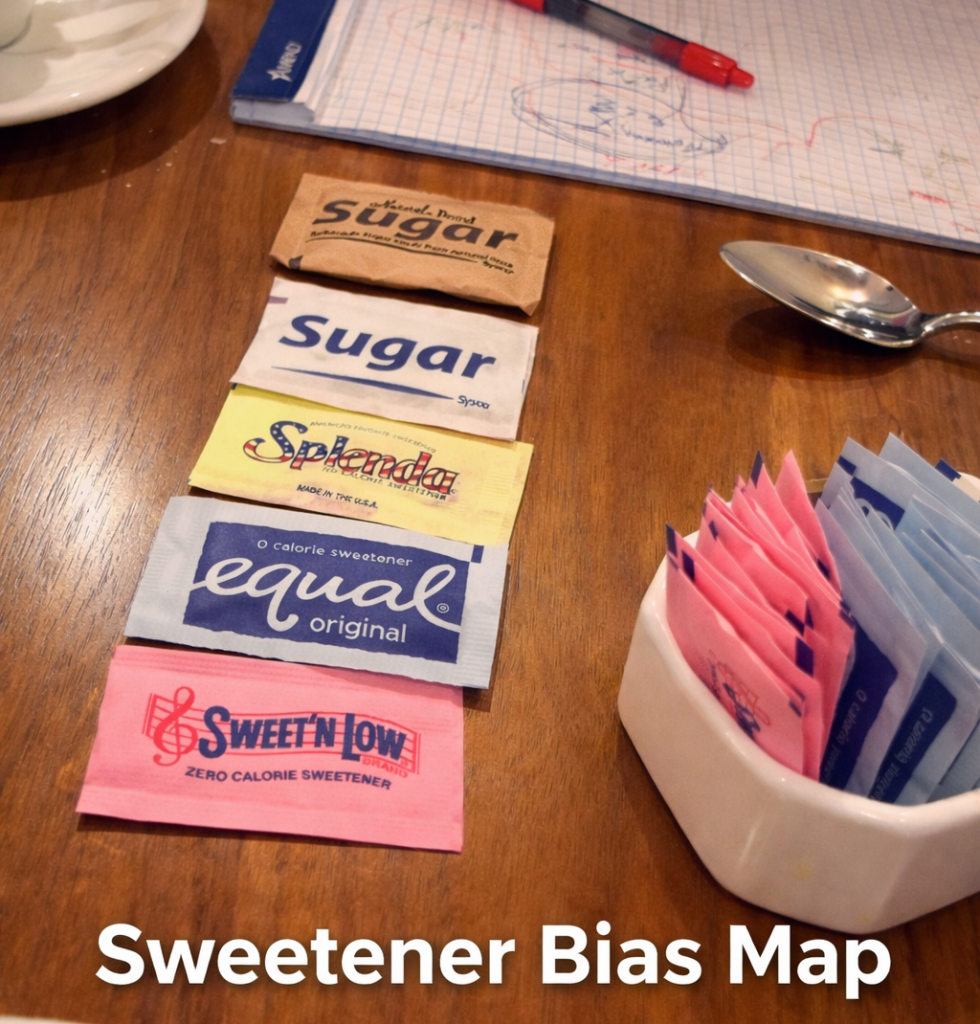
(The Original Sweetener Bias Map Picture. Taken 2017)
Why Competing Head-On Almost Always Fails
Many businesses say:
- “We’re the next Google.”
- “We’re going to replace Amazon.”
- “We’re disrupting consulting.”
Strategically, this reveals a misunderstanding of bias maps.
You do not usually win by removing the top player.
You win by fragmenting the category.
Examples:
- Amazon did not replace Google; it became product search
- YouTube did not replace Google; it became video search
- Etsy and eBay did not replace Amazon; they specialized in where and how people search
They succeeded by creating sub-bias maps, not by attacking the core one.
Positioning Is Relative, Not Absolute
Most people think positioning means:
“Where do I place this?”
Strategy asks a different question:
“Where does this sit relative to everything else?”
Positioning only makes sense in context.
The same product can be:
- Premium in one bias map
- Invisible in another
Ignoring relative position leads to:
- Overclaiming
- Credibility loss
- Confused marketing
- Misaligned expectations
Why Marketing Posture Matters
Consider consulting.
At the top of the bias map are firms like:
- McKinsey
- BCG
- Bain
- Deloitte
A solo consultant pretending to occupy that slot doesn’t appear premium.
They appear misaligned.
Bias maps enforce behavioral expectations.
If you are not at the top:
- You cannot act like you are
- You must adopt a posture that fits your position
Correct posture builds trust faster than exaggerated claims ever could.
Bias Is Not a Flaw—It Is a Requirement
The word “bias” is often treated as negative.
Strategically, that is incorrect.
Bias is what allows action.
Without bias:
- Every decision would drain mental energy
- Every purchase would feel overwhelming
- Every choice would require justification
Bias maps reduce cognitive load by pre-deciding.
This is why:
- Decision fatigue is real
- Familiar brands feel safe
- Disruption feels emotionally uncomfortable
You are not just changing logic—you are disrupting emotional stability.
Why Bias Maps Shape Emotion, Not Just Behavior
Bias maps don’t just tell us what to choose.
They tell us what not to worry about.
That is why violations feel disturbing:
- Contaminated products
- Broken norms
- Unexpected behavior
When a bias map breaks, anxiety replaces automation.
This is why trust is strategic—not cosmetic.
How to Use Bias Maps Strategically (Without Manipulation)
Bias maps should not be used to deceive.
They should be used to:
- Understand how decisions are already structured
- Identify where trust already exists
- Find honest differentiation
The strategic questions are:
- What bias map already exists in this market?
- Where am I currently placed within it?
- What adjacent position can I credibly occupy?
This is the foundation of sustainable positioning.
Why Most Businesses Fail Early
Most businesses don’t fail financially at first.
They fail positionally.
They choose:
- The wrong comparison set
- The wrong reference points
- The wrong mental category
By the time results show up, the failure has already happened—quietly, in the mind.
That is why positioning must be solved before execution scales.
Frequently Asked Questions
What is a bias map in business strategy?
A bias map is the mental hierarchy people use to rank options in a category, determining what they consider first and what they ignore.
How are bias maps different from cognitive bias?
Cognitive biases are errors. Bias maps are structures. They are necessary for efficient decision-making.
Can a business change an existing bias map?
Rarely at the top level. Most wins come from fragmenting categories or creating new sub-hierarchies.
Why is positioning mostly a mental problem?
Because markets are navigated through perception before evaluation. If you are not mentally placed, you are not considered.
Strategy begins in the mind. Execution follows. If you want both aligned, contact me at [email protected] or book a call:
This article belongs to the Strategy knowledge branch:
https://gabebautista.com/essays/strategy