Go to Amazon and Get a Copy of “Remote Work for a Better World”
The 3 Stages of Remote Work: From Individual Productivity to Fully Distributed Companies
Remote work didn’t just arrive overnight. It accelerated a trajectory that had been forming for decades.
What most people miss is that remote work is not a single skill — it’s a progression. And if you skip steps, things break.
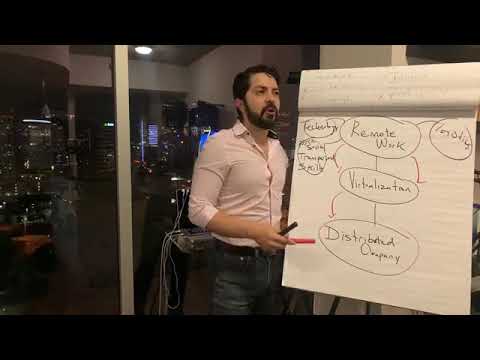
In practice, organizations that succeed remotely move through three distinct stages:
- Remote Work (the individual layer)
- Virtualization (the team and process layer)
- Distributed Companies (the organizational layer)
Let’s break these down — and why skipping ahead creates chaos.
Stage 1: Remote Work — Mastering the Individual Layer
Remote work starts with the individual, not the company.
Before teams or organizations can operate virtually, each person has to figure out three things:
1. Technology (Tools ≠ Capability)
Most people think remote work is just installing Zoom.
That’s wrong.
Zoom is just a tool. What matters is:
- How you use it
- Which tools work together
- When each tool is appropriate
This is where tool chains matter — intentional combinations of tools that support specific workflows (sales calls, project meetings, interviews, podcasts, training sessions, etc.).
Remote competence isn’t one platform.
It’s orchestrated systems.
2. Psychosocial & Transpersonal Skills
Working from home exposes things people never had to face before:
- Attention span
- Self-discipline
- Energy management
- Identity and presence on camera
- Communication clarity without physical proximity
Remote work is not easier work — it’s more intentional work.
Small things matter:
- Eye contact with the camera
- Audio quality
- Lighting
- Background
- Posture
- Tone
Your digital square becomes your professional identity.
3. Logistics & Environment
Where do you work?
- A dedicated space?
- Shared living environment?
- Noise?
- Lighting?
- Interruptions?
Different roles require different setups:
- A salesperson on video all day ≠ an engineer working asynchronously
- A podcaster ≠ a project manager
Remote work fails when logistics are ignored.
The “Dumbbell Effect”
Most people fall into one of two traps:
- “This is so easy — I don’t need to learn anything.”
- “This is impossibly hard — nothing works.”
Both are wrong.
Remote work is learnable, but not casual.
Stage 2: Virtualization — Turning Individuals into Functional Teams
Here’s the key insight:
Companies don’t work remotely. People do.
Virtualization is the process of:
- Combining individually capable remote workers
- Into coordinated virtual teams
- Around specific workflows and outcomes
This includes:
- Virtual sales processes
- Virtual onboarding
- Virtual project management
- Virtual training
- Virtual operations
Some work can be virtualized.
Some work cannot.
A mining company can virtualize:
- Planning
- HR
- Training
- Administration
But not the physical act of mining itself.
Virtualization is about clarity, not ideology.
Stage 3: Distributed Companies — Teams of Teams
A distributed company isn’t just “remote-friendly.”
It means:
- Sales
- Marketing
- Operations
- Engineering
- HR
…are all functioning as interconnected virtual systems.
Some companies operate with:
- A small physical hub
- Fully remote satellites
- Periodic in-person retreats
This is the model used by companies like the organization behind WordPress, Automattic, and tools like Slack.
Physical gatherings are used strategically, not habitually — primarily to deepen trust and communication that supports long-term virtual collaboration.
Why This Isn’t Temporary
Remote and distributed work:
- Predates crises
- Survives crises
- Accelerates during crises
Organizations discover:
- Reduced overhead
- Greater flexibility
- Access to global talent
- Resilience under pressure
Once companies experience this efficiency, they don’t fully revert.
The Real Competitive Advantage
The winners aren’t the companies that:
- “Wing it”
- Hope things go back to “normal”
- Treat remote work as a temporary inconvenience
The winners are the ones who:
- Design intentional systems
- Define workflows
- Clarify ownership
- Communicate with precision
- Treat remote execution as a core competency
Remote work isn’t a perk.
It’s an operating system.
Final Thought: You Can Deal Yourself a Better Hand
Right now, everything is being reshuffled.
Unlike poker, life allows intentional preparation.
Those who learn:
- Remote execution
- Virtual collaboration
- Distributed leadership
…will emerge several steps ahead — not because they predicted the future, but because they prepared for it.
FAQ
What is the difference between remote work and distributed companies?
Remote work focuses on individuals working outside a centralized office. Distributed companies operate entirely through virtual systems where teams, processes, and leadership are designed for remote execution.
Is remote work just about using Zoom?
No. Zoom is a tool. Effective remote work depends on tool chains, workflows, communication practices, and individual discipline.
Can all jobs be done remotely?
No. Some roles can be partially virtualized, while others require physical presence. The key is identifying what can and cannot be virtualized.
Why do distributed companies still meet in person?
In-person gatherings strengthen trust, communication, and social cohesion — which improves long-term virtual collaboration.
Ready to make this operational?
If you want help designing remote-first workflows, distributed team systems, or execution frameworks that actually work in practice, reach out.
📩 Email me at: [email protected] or Book a Call:
This Blog is part of my Strategy knowledge branch. Where I share frameworks around how organizations adapt, reposition, and execute under changing conditions.