Author name: Gabe Bautista

Categories of Categories.

Categories of Categories: How We Build Meaning Through Mental “Boxes” (and Why Positioning Depends on Them) Last time I got a little intense talking about expression—about being able to explore what’s true, what isn’t, and how truth can be different from “facts” even when people are staring at the same information. That tension matters because […]

Categories of Categories. Read More »

Why “Think Before You Speak” Sounds Wise—and Still Misses the Point

Why “Think Before You Speak” Sounds Wise—and Still Misses the Point There’s a phrase that circulates constantly online, usually presented as a neat moral checklist: Before you speak, THINK.Is it True?Is it Helpful?Is it Inspiring?Is it Necessary?Is it Kind? I understand why people like it. It gestures toward restraint, empathy, and responsibility. But the more

Why “Think Before You Speak” Sounds Wise—and Still Misses the Point Read More »

Problem Solving Continued

Complex Problems Don’t Have Single Causes — They Have Territories When we talk about problem-solving, we usually mean identifying what’s wrong, isolating it, replacing it, and moving on. That approach works well in simple systems—machines, equations, controlled environments. It fails almost everywhere else. In real life, the variables that matter are rarely isolated. They influence

Problem Solving Continued Read More »

Problem Solving with Interdependent Variables

This and That: Why Complex Problems Don’t Have a Single Cause Most people try to solve complex problems by asking the wrong question. They ask:“What is the problem?” That question assumes there is one problem—one faulty component, one bad decision, one person, one variable—that can be isolated, removed, or replaced so everything else snaps back

Problem Solving with Interdependent Variables Read More »

Facebook Developer’s Conference F8 – 2019: My Takes.

At the Facebook Developers Conference (F8) in San Jose, one word dominated the conversation: privacy. Across keynotes and developer sessions, the message was consistent—Facebook (now Meta) is emphasizing self-policing, internal regulation, and artificial intelligence as mechanisms to manage harmful content, hate speech, and platform safety. On the surface, this sounds reasonable. Necessary, even. But beneath

Facebook Developer’s Conference F8 – 2019: My Takes. Read More »

Categories Part 2: Opportunities

Categories, Part 2: Where the Real Opportunities Live In the previous discussion on categories, we explored why categories aren’t just helpful—they’re essential. They allow us to simplify a complex world, group problems instead of treating everything as a one-off, and make decisions without drowning in information. In this follow-up, the focus shifts to something more

Categories Part 2: Opportunities Read More »

Systems: Categories and Friction. Axioms of productivity.

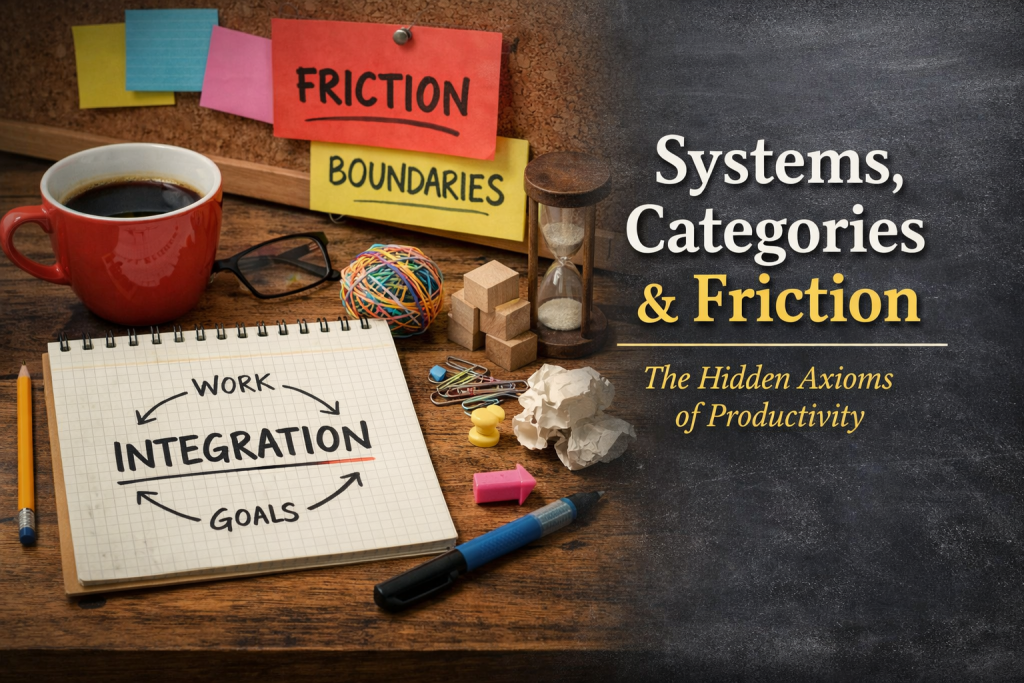
Systems, Categories, and Friction: The Hidden Axioms of Productivity Productivity problems are rarely about effort.They’re almost always about friction. That friction doesn’t come from laziness or lack of intelligence. It comes from how systems are structured, how categories are formed, and how many boundaries exist between the things that need to work together. This is

Systems: Categories and Friction. Axioms of productivity. Read More »

Tactics? Strategies? What is the real use and difference between the two. The Action continuum

Tactics vs. Strategy: what’s the real difference (and why it matters) If you’re trying to change anything—your business, your career, your health—your first point of contact with reality isn’t a strategy deck. It’s action. And action is powered by tactics: small, testable moves that meet the world where it is. Most people talk about “strategy”

Tactics? Strategies? What is the real use and difference between the two. The Action continuum Read More »

Coaching: The difference between professionals and amateurs.

Coaching: The Difference Between Professionals and Amateurs When I’m brought in as a consultant, it’s usually because there’s a problem that needs fixing. Something is broken, stalled, or producing symptoms that can no longer be ignored. But once the diagnostic process begins, a pattern shows up again and again: the visible problem is rarely the

Coaching: The difference between professionals and amateurs. Read More »

Creativity PART 2. More thoughts on Creativity.

Great Art Feels Dangerous (and That’s the Point) Creativity is one of those words everybody loves… until it shows up in a form they don’t recognize. A few days ago I recorded a long talk on creativity—philosophical, abstract, probably a little too deep for what people expect when they hear the word creative. Then I

Creativity PART 2. More thoughts on Creativity. Read More »

Creativity: Blessing? Curse? How to make the most of it.

Creativity: A Blessing or a Curse? A Pragmatic Look at Creative Power Creativity is one of those words we all use, but rarely slow down to examine. Like love, justice, or fairness, it carries so much meaning that it often functions as a low-resolution shortcut—a thumbnail for something far deeper and more complex. Are you

Creativity: Blessing? Curse? How to make the most of it. Read More »

Politics and Religion: Why We Fight About What We Believe.

Politics and Religion: Why We Fight About What We Believe There are two topics everyone says you should never bring up at a party: politics and religion. That advice exists for a reason. These subjects don’t just create disagreement. They create heat. They trigger identity. They can fracture families. They can polarize communities. And at

Politics and Religion: Why We Fight About What We Believe. Read More »

Levels of Abstraction of Personal and Societal Organization

Levels of Abstraction in Personal and Societal Organization Life is complicated. Society is complicated. And if we want to act—really act—we have to simplify. We categorize. We filter. We compress reality into something we can hold in our minds long enough to make a decision. That’s not a flaw. It’s a survival feature. The problem

Levels of Abstraction of Personal and Societal Organization Read More »

The Frame Problem. A.I. And machine learning insight for your Company.

“No one ever failed to find the Facts they were looking for” – Peter Drucker. The Frame Problem: What AI and Machine Learning Reveal About Blind Spots in Your Business Most business failures don’t happen because teams lack intelligence, data, or effort.They happen because organizations fail to see what actually matters. In artificial intelligence and

The Frame Problem. A.I. And machine learning insight for your Company. Read More »