Why “Think Before You Speak” Sounds Wise—and Still Misses the Point
There’s a phrase that circulates constantly online, usually presented as a neat moral checklist:
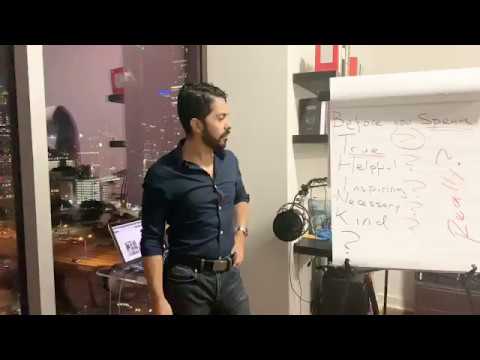
Before you speak, THINK.
Is it True?
Is it Helpful?
Is it Inspiring?
Is it Necessary?
Is it Kind?
I understand why people like it. It gestures toward restraint, empathy, and responsibility. But the more seriously I take it, the less coherent it becomes—philosophically, psychologically, and even practically.
Not because thinking before speaking is bad.
But because this rule quietly demands something impossible: certainty before articulation.
And that demand has consequences.
You Can’t Know These Things in Advance
How do you know something is true before you say it?
Knowing something is false is not the same thing as knowing it’s true. Truth is not usually discovered in silence. It emerges through articulation, testing, disagreement, and refinement. Speech is not merely the transmission of finished thoughts—it is how unfinished thoughts become clear.
The same problem applies to the rest of the checklist.
How do you know something will be helpful before you say it?
How do you know it will inspire someone?
Inspiration is, by definition, something recognized after the fact.
How do you know it’s necessary, and for whom?
How do you know it will land as kind?
Most of these qualities are not properties of statements. They are properties of relationships and contexts, revealed only once something is said.
So the rule doesn’t actually teach wisdom. It teaches hesitation.
Speech Is a Tool for Discovery, Not Just Control
Speech is often treated as something dangerous—something that must be carefully filtered lest it cause harm. But speech has another function that rarely gets acknowledged: it is how human beings discover what they think.
We do not speak only because we know.
We speak because we don’t know.
We speak to find out what we believe, what we feel, and what might be true.
When we insist that people resolve truth, usefulness, necessity, inspiration, and kindness before speaking, we collapse speech into performance. Only polished, pre-approved thoughts are allowed through.
Everything else stays inside.

Where Anxiety Enters the Picture
I’ve struggled with anxiety for most of my life. For a long time, I didn’t recognize it because it was simply the baseline—the water I was swimming in.
What I eventually noticed is that anxiety often correlates with internal fragmentation: parts of yourself that are not allowed to speak, even to each other.
Thoughts don’t disappear when they’re suppressed. They turn inward. They collide. They generate tension. Over time, that tension becomes psychological noise—restlessness, dread, unease, depression.
I’m not claiming anxiety has a single cause. Complex systems don’t work that way. Biology, chemistry, history, trauma, and temperament all matter. There is no privileged point of causation.
But silence matters too.
The Cost of Pre-Censorship
When people are afraid to speak because they might be wrong…
Because they might not be helpful…
Because they might be criticized for being unnecessary or unkind…
They don’t become wiser.
They become quieter.
And quiet doesn’t mean integrated. Often it means fragmented.
This echoes a thought associated with Michel de Montaigne: if you are afraid of being hurt, you are already being hurt by fear itself.
The same applies to speech. If you are afraid of speaking wrongly, you are already paying the psychological cost of that fear.
Lies of Omission—Even Internally
Many of the most damaging lies we tell are not lies we speak. They are lies we refuse to articulate—even to ourselves.
There are thoughts we avoid because they feel shameful. Feelings we won’t name because they feel dangerous. Questions we won’t ask because we fear the answer.
That avoidance splits us. Parts of us hold incompatible stories that never get reconciled because they never meet in language.
Speech—even clumsy, risky speech—is often what brings those parts back into dialogue.
Why We Need to Risk Saying the Wrong Thing
I’ll defend the right of people to say things that are shallow, incomplete, or even wrong.
Not because those ideas are correct—but because conversation requires risk.
Someone says something questionable.
Someone else responds, “I think that’s wrong—and here’s why.”
The first person answers back.
Understanding sharpens.
That process is not cruelty. It’s how thinking works in public.
Sometimes what you say won’t be helpful.
Sometimes it won’t be inspiring.
Sometimes it won’t be kind.
But if you never risk being wrong, you never get closer to what’s true.
Speech is not only a moral act.
It is an ontological one.
It’s how we discover what we are, what we believe, and what might actually hold together.
FAQ
Is thinking before speaking a bad thing?
No. Reflection matters. The problem is demanding certainty before expression, which suppresses exploration and honest dialogue.
How does self-censorship relate to anxiety?
Suppressing thoughts fragments internal dialogue, increasing unresolved tension that often manifests as anxiety or depression.
Is speech necessary to discover truth?
Often, yes. Many ideas become clear only when articulated and tested in conversation.
Does this justify saying harmful things?
No. It argues for risk in honest expression, not cruelty. Ethical responsibility still applies—but it cannot be pre-calculated perfectly.
Why defend poorly formed ideas?
Because conversation allows ideas to evolve. Silence prevents correction; dialogue enables refinement.
I work with founders and teams navigating ambiguity, meaning, and execution—reach out at [email protected] or book a call:
This essay connects to a broader exploration of meaning, identity, and internal coherence. Access the meaning knowledge branch here:
https://gabebautista.com/essays/meaning/