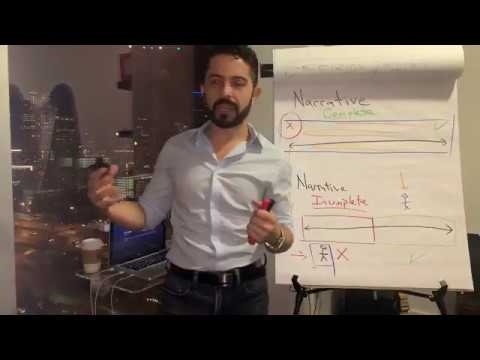
Incomplete Narratives: Why the Brain Needs Stories (and Why They Can Mislead Us)
Why Narratives Matter More Than Facts
Human beings do not experience reality as a list of isolated facts. We experience reality as stories.
This is not a cultural preference or a literary habit—it’s a cognitive necessity. The brain is not optimized to hold infinite details. Instead, it compresses reality into narratives: sequences of causes and effects that allow us to remember, predict, and act without re-analyzing every variable from scratch.
A narrative is not just a story we tell others.
It’s the structure through which we understand the world.
When a narrative works well, we don’t need to remember every detail. We remember the story, and the details come back when needed. This is efficient, practical, and unavoidable.
The problem is not that we rely on narratives.
The problem is which narratives we rely on—and whether they are complete.
The Brain as a Compression Machine
From a cognitive standpoint, narratives function as compression algorithms.
Instead of holding thousands of discrete data points, the brain organizes information into patterns:
- This happened, therefore that happened.
- This kind of person usually behaves this way.
- This type of situation tends to end like this.
Without narratives, decision-making would grind to a halt. You would need to re-evaluate every situation from zero, every single time.
So narratives reduce cognitive load.
They allow speed.
They allow memory.
They allow action.
But compression always comes with loss.
And that loss becomes dangerous when the narrative deletes part of reality instead of summarizing it.
Narratives, Labels, and Positioning
This is where narratives become especially important in positioning.
Positioning works by attaching a label to a narrative.
A label draws a conceptual boundary. Once something has a label, you no longer have to think about all of its internal complexity. The label stands in for the story.
That’s powerful.
In business, positioning allows:
- Faster decisions
- Clear differentiation
- Reduced uncertainty
- Predictable expectations
A well-positioned idea, product, or person fits neatly into a mental category. The brain relaxes. The work is done.
But labels only work when the narrative behind them is accurate and sufficiently complete.
When Narratives Work Well
A complete narrative reflects reality as a spectrum, not a binary.
It acknowledges:
- Strengths and weaknesses
- Upside and downside
- Benefits and costs
- Capability and limitation
Most great stories—myths, novels, films—work precisely because their characters are not one-dimensional. Protagonists have flaws. Antagonists have motives. The tension between opposing forces makes the story believable.
Complete narratives allow navigation.
They give you room to think, adapt, and respond.
Incomplete narratives remove that room.
The Core Problem: Incomplete Narratives
An incomplete narrative does not merely simplify reality.
It deletes part of it.
Instead of saying:
“This has positives and negatives.”
It says:
“This is good.”
or
“This is bad.”
One side of the spectrum disappears entirely.
And once that happens, thinking stops.
The narrative fills in all future interpretation automatically. Every new piece of information is forced to fit the existing frame—or ignored.
This is where labels stop being tools and start becoming filters that block perception.
Why This Matters Before We Go Further
Up to this point, none of this is moral, political, or personal. It’s structural.
If you understand:
- That the brain relies on narratives,
- That labels are compressed narratives,
- And that compression always risks distortion,
then the real danger becomes visible.
Because the most destructive narratives are not the ones that are false.
They are the ones that are partially true, emotionally satisfying, and incomplete.
That’s where things like:
- “toxic people”
- one-sided pitches
- ideological caricatures
- moral absolutism
begin to emerge.
And that’s where the real damage starts.
What Comes Next
Now that the structure is clear:
- how narratives work,
- how labels shape perception,
- and how incompleteness enters,
the next step is to look at how this plays out in real life, especially in:
- relationships,
- culture,
- business,
- and modern language around “toxic people.”
That’s where theory turns into consequence.
When Incomplete Narratives Become Dangerous
Incomplete narratives are not just intellectual mistakes.
They are behavior-shaping structures.
Once a narrative collapses reality into a single dimension—good or bad—it doesn’t merely describe the world. It tells you how to act in it.
And that’s where things get risky.
The “Toxic People” Label as a Case Study
One of the clearest modern examples of an incomplete narrative is the idea of “toxic people.”
The term feels useful.
It feels protective.
It feels decisive.
But conceptually, it does something very specific: it turns behavior into identity.
A person is no longer someone who acts resentfully, arrogantly, deceitfully, irresponsibly, or anxiously at times.
They are toxic.
Once that label is applied, the narrative is closed.
There is nothing left to learn.
Nothing left to hear.
Nothing left to interpret.
The story is finished.
Behavior Is Not Identity
Almost no human being acts one way 100% of the time.
Even people who are deeply resentful, envious, arrogant, or deceitful will—at some point—show:
- responsibility,
- honesty,
- gratitude,
- or care.
That doesn’t make their negative behavior harmless.
But it does mean that a single label cannot fully describe a person.
A complete narrative would say:
This person has patterns that are harmful and moments that are not.
An incomplete narrative says:
This person is toxic.
That distinction matters because it determines whether feedback is even possible.
Why Incomplete Narratives Shut Down Learning
Once someone is placed inside a one-dimensional box, everything they say becomes irrelevant.
You don’t have to evaluate their arguments.
You don’t have to examine their criticism.
You don’t have to consider whether they might be right about something.
The label does all the work for you.
This is psychologically comforting—but strategically disastrous.
Because some of the most important feedback you’ll ever receive will come from:
- people who are unpleasant,
- people who express themselves badly,
- people who don’t like you,
- people who trigger defensiveness.
If your narrative automatically disqualifies the messenger, you may never examine the message.
The Pathological Turn: Moral Sorting
The most dangerous form of incomplete narrative emerges when you place yourself entirely on the “good” side of the spectrum, and everyone else on the “bad” side.
At that point:
- You are no longer navigating reality.
- You are sorting people into moral categories.
- You are no longer listening; you are filtering.
This is not just a personal problem.
It becomes social and political very quickly.
The Difference Between Distance and Denial
There are situations where creating distance from someone is necessary.
You may decide:
- This relationship is not healthy for me.
- This dynamic is unproductive.
- This person cannot currently be part of my life.
That decision can be valid.
But the difference between responsible distance and narrative denial is awareness.
A responsible decision says:
I may be wrong. I’m making the best call I can with limited information.
An incomplete narrative says:
I’m right. This person is the problem. End of story.
One leaves the door open for learning.
The other locks it permanently.
The Benign Version: Incomplete Narratives in Sales
Incomplete narratives aren’t always malicious. Sometimes they’re just shallow.
The most common benign example is a sales pitch.
A pitch often emphasizes:
- upside,
- opportunity,
- reward,
- success stories.
And minimizes:
- risk,
- tradeoffs,
- constraints,
- failure modes.
That’s not automatically unethical—but it is incomplete.
A complete pitch explains the full spectrum:
- what could go right,
- what could go wrong,
- what this requires,
- and who this is not for.
Ironically, completeness builds more trust than optimism.
When Incompleteness Becomes Ideological
The most dangerous incomplete narratives appear in politics and ideology.
Political movements thrive on simplified moral stories:
- We are right.
- They are wrong.
- We are good.
- They are dangerous.
Ridicule replaces understanding.
Memes replace arguments.
One side of the spectrum disappears.
Once that happens, truth becomes irrelevant.
Because truth is not evaluated by accuracy—it’s evaluated by which side said it.
Even the worst person in the world can say something true.
Truth does not become false because of its source.
Incomplete narratives erase that possibility.
Why This Feels So Compelling
Incomplete narratives feel good because they:
- reduce uncertainty,
- simplify decisions,
- remove internal conflict,
- protect identity.
They give the illusion of control in a complex world.
But that control is artificial.
You don’t gain clarity—you lose perception.
The Real Cost of One-Sided Stories
When narratives collapse into absolutes:
- feedback loops break,
- learning slows,
- adaptation stops,
- and error compounds silently.
This applies to:
- relationships,
- business decisions,
- political beliefs,
- personal identity.
Incomplete narratives don’t just misrepresent reality.
They prevent correction.
And systems that cannot correct eventually fail.
Transition Forward
So far, we’ve looked at:
- how narratives work,
- how labels compress reality,
- and how incomplete narratives distort people, pitches, and politics.
What remains is a deeper question:
Why do we rely on these shortcuts so heavily—and why are they so hard to escape?
To answer that, we need to look at:
- how culture pre-builds narratives,
- how pattern recognition works in the brain,
- and where moral clarity actually lives.
That’s where this goes next.
Why We Rely on Incomplete Narratives in the First Place
Incomplete narratives don’t dominate because people are stupid or malicious.
They dominate because human life would be impossible without shortcuts.
We do not have enough time, energy, or cognitive capacity to analyze every situation from first principles. So culture does part of the work for us in advance.
Culture hands us:
- scripts,
- roles,
- expectations,
- procedures,
- and default interpretations.
Most of the time, this is a feature—not a bug.
How Culture Pre-Builds Our Stories
Human learning happens in layers.
Before we can explain things, we imitate.
Before we reason abstractly, we act out episodes.
Only later do we articulate meaning.
In other words:
- We learn procedures first.
- Then we live them as experiences.
- Then we describe them with language.
This is why walking into a restaurant already tells you how to behave.
The room, the furniture, the staff, the flow—all of it forms a narrative that reduces uncertainty.
You don’t need to think.
You just play the role.
Narratives calm the nervous system because they make the world predictable.
Pattern Recognition: The Brain’s Core Function
At the deepest level, the brain is a pattern-recognition machine.
It detects:
- repetitions,
- similarities,
- deviations,
- and trends across time.
This is what allows learning, memory, and anticipation.
But pattern recognition exists on a spectrum.
- Too little pattern recognition, and you miss real signals.
- Too much pattern recognition, and you see patterns that aren’t there.
At one extreme, reality feels chaotic and meaningless.
At the other extreme, everything feels connected, intentional, and threatening.
Balance lives in the middle.
Complete narratives help maintain that balance.
Incomplete narratives push us toward distortion.
Why Art and Music Reveal Something Important
This is one reason minimalist music is so compelling.
Repetition with variation mirrors reality itself.
Nothing is static.
Everything unfolds over time.
An object is not just a thing—it is a pattern across moments.
A person is not just a trait—they are a trajectory.
Good stories understand this intuitively.
Bad stories freeze reality in place.
Incomplete narratives try to turn patterns into permanent identities.
The Moral Question We Can’t Avoid
Eventually, every narrative collapses into a moral question:
Where is the line between good and bad?
If that line were clean and external—good people over here, bad people over there—the problem would be easy. We could isolate the bad, remove it, and be done.
But reality doesn’t work that way.
As Aleksandr Solzhenitsyn famously observed, the line between good and evil does not run between groups. It runs through every human heart.
That insight destroys every simplistic moral narrative.
Because it means:
- there are no purely good people,
- no purely evil people,
- and no labels that can absolve us from responsibility.
What a Complete Narrative Actually Requires
A complete narrative does not deny harm.
It does not excuse bad behavior.
It does not demand infinite tolerance.
What it requires is awareness.
Awareness that:
- people contain contradictions,
- ideas have tradeoffs,
- decisions carry risk,
- and certainty is often emotional, not rational.
A complete narrative keeps both sides of the spectrum visible—even when one side is uncomfortable.
Responsibility Is the Price of Completeness
Incomplete narratives feel easier because they reduce responsibility.
If someone is “toxic,” you don’t have to listen.
If an idea is “bad,” you don’t have to understand it.
If your side is “good,” you don’t have to self-examine.
Complete narratives remove those escapes.
They force you to:
- evaluate instead of dismiss,
- navigate instead of sort,
- and take responsibility for judgment.
That is harder—but it’s also where learning happens.
The Practical Question to Keep Asking
Whenever you encounter a strong claim, a strong emotion, or a strong label, ask:
What part of the spectrum is missing from this story?
If you can’t answer that, you’re not seeing the whole thing.
That doesn’t mean you can’t decide.
It means you decide with humility, knowing revision may be necessary.
Closing Thought
The world is complex.
People are contradictory.
Truth is rarely one-sided.
Incomplete narratives promise clarity—but deliver blindness.
Complete narratives don’t make life simple.
They make it navigable.
And navigation, not certainty, is what responsibility actually looks like.
FAQ
What is an incomplete narrative?
An incomplete narrative is a story that explains reality using only one side of a spectrum—good or bad—while ignoring opposing factors like risk, tradeoffs, or complexity.
Why do humans rely on narratives?
The brain uses narratives to compress complex information into cause-and-effect patterns, making memory and decision-making faster and more efficient.
Why are incomplete narratives dangerous?
They shut down learning and feedback by turning behaviors into identities, removing nuance, and preventing self-correction.
Are “toxic people” an example of an incomplete narrative?
Often, yes. The label collapses behavior into identity and removes the obligation to evaluate context, change, or feedback.
What is a complete narrative?
A complete narrative acknowledges the full spectrum of reality—both positive and negative aspects—allowing for better judgment and adaptation.
How do incomplete narratives affect business decisions?
They create overconfidence, hide risk, exaggerate upside, and lead to poor strategic choices by removing downside consideration.
How can I recognize when I’m using an incomplete narrative?
If a label feels emotionally satisfying, absolute, or dismissive—and removes the need to listen—it’s likely incomplete.
I work with founders, teams, and organizations to turn complex thinking into executable strategy. If that’s useful, contact me at [email protected] or book a call:
This essay connects to broader reflections on meaning, narrative, and how humans make sense of reality explored at in the “meaning” knowledge branch:
https://gabebautista.com/essays/meaning/