
In early 2021, a handful of stocks—GameStop, AMC, and BlackBerry—became the center of one of the most unusual events in modern market history.
The headlines focused on chaos, memes, and outrage.
But beneath the noise was something much more interesting: a structural lesson about markets, incentives, and coordination.
This article explains:
-
What it actually means to short a stock
-
Why the GameStop short squeeze happened when it did
-
What this event permanently changed about public markets
This is not a political take. It’s an entrepreneur’s perspective—from someone who thinks in terms of value creation, feedback loops, and system dynamics.
Stocks Are Only Two Things: Price and Time
At its most fundamental level, a stock has:
-
Price
-
Time
Everything else—volatility, momentum, narratives—is just the interaction between those two variables.
Markets exist to solve a nearly impossible problem:
What is something actually worth?
No single person can calculate that. So markets rely on many participants placing real bets, each with different information, incentives, and expectations.
That’s why markets move.
How Most People Make Money: Buying Stocks
The intuitive case is simple:
-
You believe a company will do well
-
You buy the stock at today’s price
-
If the price rises, you sell later
-
The difference is your profit
This is how most people understand investing.
But markets also need participants who believe the opposite.
What It Means to Short a Stock (And Why It’s Not Unethical)
Short selling exists for one reason: price discovery.
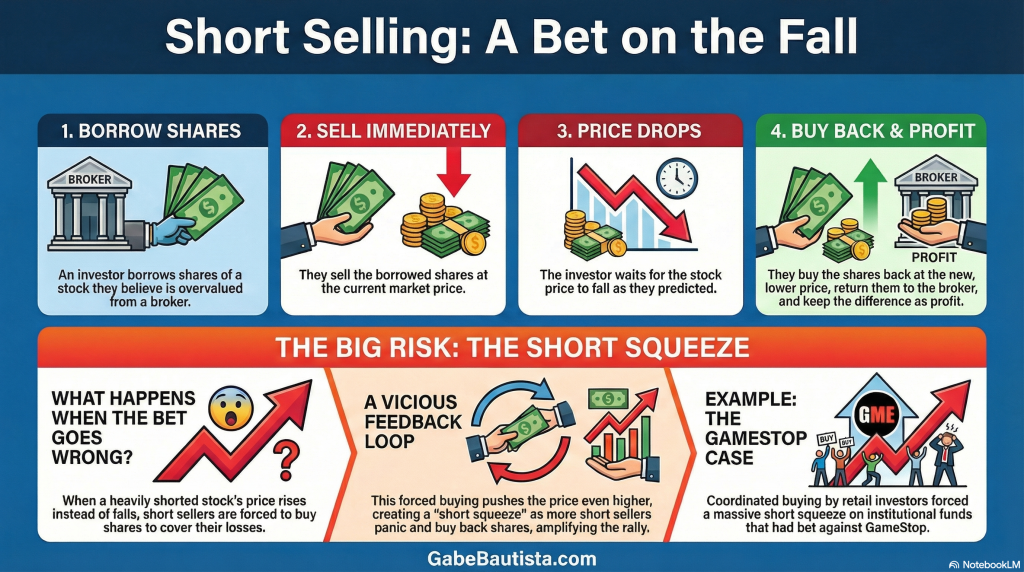
Here’s how it works:
-
You believe a stock is overvalued
-
You borrow shares from a broker
-
You sell them at the current price
-
If the price falls, you buy them back cheaper
-
You return the shares and keep the difference (minus interest)
That’s it.
Short sellers are not parasites. They provide negative information to the market—just as buyers provide positive information.
If you believe shorting is unethical, you must also believe buying is unethical. Both are opinions expressed through capital.
Why GameStop Was Different
GameStop wasn’t just being shorted.
At one point, it was shorted over 100% of its available shares.
That meant:
-
Institutional investors were extremely confident the stock would fall
-
Their positions were heavily leveraged
-
Their downside risk was massive if the price moved up instead
This created a structural vulnerability.
The Role of Retail Investors and Zero-Commission Trading
Three major shifts converged:
1. Discount Brokers Eliminated Friction
Platforms like Robinhood, TD Ameritrade, and Charles Schwab removed commissions entirely.
That changed behavior:
-
Less cost = more trades
-
Less penalty for being wrong
-
More experimentation
2. COVID Created Time + Attention
Millions of people were:
-
At home
-
Online
-
Looking for opportunity
3. Information Became Social
Retail investors could now:
-
See institutional positions
-
Coordinate through Reddit and social media
-
Act collectively instead of individually
That combination had never existed at this scale before.
What a Short Squeeze Actually Is
When a heavily shorted stock starts rising:
-
Short sellers begin losing money
-
Losses grow as price rises
-
At some point, they are forced to buy to cover their position
That buying pushes the price even higher.
This feedback loop is called a short squeeze.
In GameStop’s case:
-
Retail buyers pushed the price up
-
Short sellers panicked and bought to limit losses
-
Their buying amplified the rally
-
The squeeze fed on itself
This wasn’t accidental.
It was coordinated, legal, and rational within the rules of the market.
Why Trading Halts Were the Most Dangerous Precedent
The most troubling outcome wasn’t volatility.
It was that some platforms restricted buying but allowed selling.
That violated a core principle of public markets:
Equal access to transact.
If markets are a “farmer’s market,” then you don’t get to:
-
Close stalls selectively
-
Decide who is allowed to buy
-
Intervene based on who is winning
That moment did more long-term damage to trust than any meme trade ever could.
The Real Implications for the Future
1. Retail Investors Are Now a Market Force
This event proved coordination is possible at scale.
That reality is now permanently priced into markets.
2. Regulation Will Be Proposed (And Mostly Misguided)
Regulation is always framed as “protection,” but often:
-
Raises barriers to entry
-
Favors institutions
-
Reduces participation
Markets don’t need protection from people taking risk with their own money.
3. Markets Are Still About Responsibility
At the end of every squeeze:
-
Someone holds the bag
-
Someone mistimes the exit
That’s not injustice—that’s risk.
Public markets reward insight and punish error, regardless of status.
Final Thought: Markets Are Information Engines
Markets work because people:
-
Disagree
-
Act
-
Risk capital
Short sellers contribute information.
Buyers contribute information.
Retail investors are not outsiders—they are participants.
The GameStop event wasn’t a glitch.
It was a stress test—and it revealed exactly how modern markets actually function.
FAQ
What is a short squeeze?
A short squeeze happens when rising prices force short sellers to buy shares to cover losses, driving prices even higher.
Is short selling illegal?
No. Short selling is a legal and fundamental market mechanism.
Why did GameStop rise so fast?
Because heavy short interest combined with coordinated buying created a feedback loop.
Will this happen again?
Yes—but institutions will adapt, and the conditions will be harder to replicate.